Apixaban's genotoxic impurities: USP is pulling the limits on Related Compounds F, G and H — here is what to file instead
On 17 September 2026 the USP Small Molecules 6 Expert Committee posted a Notice of Intent to Revise for the Apixaban monograph. Two of the three proposed changes are routine housekeeping — a second Organic Impurities procedure, and the residue-on-ignition criterion widening from NMT 0.1 % to NMT 0.15 % to accommodate already-approved products. The third is not routine: the committee proposes deleting the tests for the Limit of Apixaban Related Compound H, Related Compound G and Related Compound F, on the stated grounds that USP is developing a strategy for the control of mutagenic and potentially mutagenic impurities in compendial articles.[1] For a generic team mid-filing, that reads less like three tests you no longer have to run, and more like three impurities losing their official anchor — pushed back onto your own (Q)SAR assessment, your own spiking studies, and your own justification of a limit nobody has written for you. This article works through why those three came off the page, where the alerting structures in the apixaban route actually sit, and how to set and defend a limit when the monograph stops doing it for you.
Key points
- USP proposes to delete the acceptance criteria for Apixaban Related Compounds F, G and H; targeted official date 1 July 2027, comment period to 31 January 2027.
- The intact apixaban molecule carries no secondary amine — C3 is a primary amide — so a skeleton-level (Q)SAR scan returns clean. That clean result says nothing about the route.
- The real alerts come from the starting materials: 4-nitroaniline (aromatic nitro plus arylamine) and the chloroalkanoyl chain from 5-chlorovaleryl chloride, plus a diazotisation step that is itself a nitrosating environment.
- At 5 mg twice daily the ICH M7 default TTC of 1.5 µg/day converts to roughly 150 ppm in the API. That is the number your clearance study has to beat.
1. Where apixaban sits in the pharmacopoeial landscape
Apixaban (C25H25N5O4, MW 459.50, CAS 503612-47-3) is a direct, reversible factor Xa inhibitor dosed orally at 2.5 mg or 5 mg twice daily. Structurally it is a fused pyrazolo[3,4-c]pyridin-7-one core carrying a 4-methoxyphenyl group on the pyrazole nitrogen and an N-(4-(2-oxopiperidin-1-yl)phenyl) side chain.
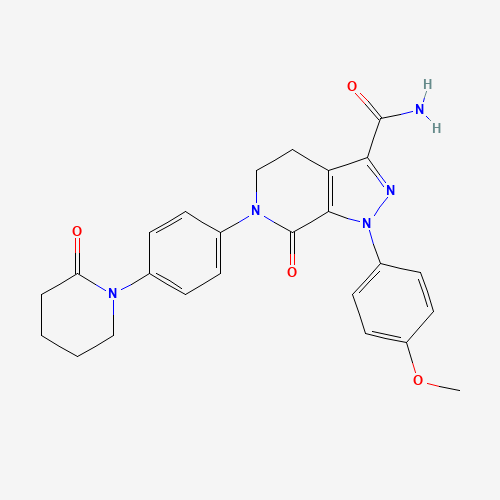
The compendial situation is unusually thin for a molecule of this commercial weight. USP carries an Apixaban monograph and is actively revising it. The European Pharmacopoeia does not include apixaban as a monograph, and EDQM does not list an apixaban chemical reference substance, so there is no official EP impurity nomenclature to appeal to. ChP and JP likewise carry no apixaban API monograph.
This matters more than it sounds. A label like "Impurity 47" is a commercial catalogue number, not a compendial designation — two suppliers can assign the same integer to two different structures and neither is wrong, because no authority allocates the numbers. Identity has to be pinned by CAS or by structure, then confirmed against relative retention in system suitability. When you compare CoAs from three vendors, that is the first place a mix-up happens.
2. What the deletion actually changes — and what it does not
Under the current monograph, Related Compounds F, G and H each have a stated limit. Once the revision takes effect, those three lose their compendial acceptance criterion. Two things follow, and one does not.
What follows. You can no longer answer "how do you control Related Compound G?" with "it complies with the USP monograph" — regulators will ask for the hazard assessment and the clearance data instead. And if any of the three is ICH M7 Class 2 or 3, the default TTC applies: 1.5 µg/day, a theoretical lifetime excess cancer risk of 1 × 10⁻⁵.[2][3]
What does not follow. The deletion is not a finding that these impurities are safe, nor a lowering of the bar. USP frames it as a transition while a mutagenic impurity strategy is developed — an admission that a single-compound limit test is the wrong tool for a cohort of structurally related potential mutagens. The ICH M7 obligation is unchanged and independent of any monograph.
That 150 ppm figure is the practical centre of gravity for the whole exercise. It is also where most methods quietly fail: a validated LOQ sitting at 140 ppm is not a method for a 150 ppm limit, it is a method that happens to pass on the day. Aim the LOQ an order of magnitude below the limit and you keep headroom for the day a reviewer asks you to demonstrate capability at 30 % of the criterion.
3. Where the alerting structures actually come from
Run the intact apixaban structure through a (Q)SAR platform and the headline result is reassuring. The C3 substituent is a primary carboxamide, −CONH2: both hydrogens are present, but it is an amide, not an amine. There is no secondary amine anywhere in the molecule, and no N-nitroso motif to find. That assessment is correct — for the drug substance.
The error is treating it as an assessment of the process. Apixaban is assembled from two fragments, and both bring alerts with them.
The piperidinone side: an aromatic nitro compound and two acyl chlorides
The published scale route starts from 4-nitroaniline, which is simultaneously an aromatic amine and a nitroaromatic — two distinct alert classes in one small molecule — and acylate it with 5-chlorovaleryl chloride, followed by cyclisation to 1-(4-nitrophenyl)piperidin-2-one. Treatment with phosphorus pentachloride then installs two chlorines at C3, giving a gem-dichloro intermediate, which morpholine converts to the enamine and sodium sulfide reduces to the 4-aminophenyl compound. A second acylation/cyclisation with the same chloroacyl chloride completes the 2-oxopiperidin-1-yl ring.[4][5]

Three alert families come out of this half of the route: the arylamine/nitroaromatic starting material and its congeners; the chloroalkanoyl chain and its hydrolysis and elimination products; and the gem-dichloro intermediate, a considerably more aggressive alkylator than a monoalkyl chloride. The monoalkyl chloride class has enough carcinogenicity data behind it for a read-across acceptable intake of 15 µg/day to be defensible — roughly ten times the generic TTC — but a gem-dichloro compound is not automatically covered by that argument, and the justification has to be written rather than assumed.[3]
The pyrazole side: a diazotisation that is also a nitrosating step
4-Methoxyaniline is diazotised with sodium nitrite and hydrochloric acid at around 0 °C, buffered to weak acidity, and coupled with ethyl 2-chloroacetoacetate by a Japp-Klingemann reaction to give (Z)-ethyl 2-chloro-2-(2-(4-methoxyphenyl)hydrazono)acetate. The hydrazone then undergoes a [3+2] nitrile imine cycloaddition that closes the pyrazole ring.[4][5]

Two conditions a nitrosamine assessment is supposed to flag are present here before any degradation chemistry is considered: the step is a nitrosating environment by construction, and the hydrazone product still carries an N–H. The corresponding N-nitroso species — one NO added, one H lost — is a process-derived impurity of the intermediate, not a degradant of the finished API, which is precisely why forced degradation under standard conditions will never reveal it.
There is a second, subtler entry point on the drug-substance side. Both lactam rings are amides, and amide hydrolysis turns an acylated lactam nitrogen into an aromatic secondary amine: opening the 2-oxopiperidin ring gives an Ar–NH–(CH2)4–CONH2 fragment, opening the fused 7-oxo ring gives an Ar–NH–CH2– carboxylic acid. Arylamine nitrogens are exactly what nitrous acid attacks. The intact molecule can be free of secondary amines while its own hydrolysis products are not.
How it compares with the other factor Xa inhibitors
The four oral Xa inhibitors get discussed as though they shared an impurity strategy. They do not. Rivaroxaban's alerting chemistry sits largely in its oxazolidinone and chlorothiophene side chain; edoxaban's in a thiazole-bearing amine side chain; dabigatran carries an amidine, basic enough to behave differently in clearance and in any nitrosation argument. Apixaban's alerts come almost entirely from two purchased starting materials rather than from a designed side chain. What the four genuinely share is the distinction this article is about: in every case the intact API looks cleaner under a skeleton scan than the route that produced it.
What should not travel between them is the clearance evidence. A log-removal factor measured on a rivaroxaban intermediate tells you nothing about a gem-dichloro apixaban intermediate, because the removal mechanism — aqueous wash, pH partition, rejection in crystallisation — depends on the specific molecule. Comparisons frame the risk question; they are not evidence for the answer.
4. How to test for this without a compendial method
Apixaban's genotoxic impurity set spans an awkward polarity range — a small polar arylamine at one end, a volatile chloroalkanoyl species at the other, ring-opened acids and amides in between. No single reversed-phase method covers that spread, and pretending otherwise is how people end up with a method that sees three of the seven compounds they need.
A workable split follows chemistry rather than convenience. Aromatic amines and nitroaromatics: reversed-phase LC with UV, or LC-MS/MS in positive mode where the limit demands it. Chloroalkanoyl species: GC with electron-capture or MS detection — volatile enough to make GC the natural fit, and the halogen gives a sensitive handle. Ring-opened acids and amides: LC-MS/MS in negative mode. We deliberately quote no column dimensions or gradients here: a condition lifted from a paper and pasted into a validation report without re-development is one of the fastest ways to fail a method transfer, and the right conditions depend on your own impurity panel.
Validation is where the work sits, and three points carry most of the regulatory weight:
- LOQ against the limit, not against the detector. For a 150 ppm criterion, demonstrate quantitation at 30–40 ppm and state the signal-to-noise and precision achieved there.
- Ion suppression at API concentration. Genotoxic methods inject a large API load to see trace impurities; matrix effects must be measured with spiked API, not neat standards.
- Forced degradation designed for the chemistry you fear. Acid, base, oxidation, heat and light will not generate a nitrosamine, because none supplies a nitrite source. A statement about nitrosamine formation requires a nitrosating stress — weakly acidic, sodium nitrite, controlled temperature and time — and then a check for whether that condition also opens the lactam rings, because if it does, your degradant profile no longer matches your stability samples.
5. What to write in the dossier
With the monograph anchor gone, the impurity section has to stand on three legs: hazard, exposure, control.
Hazard. Two complementary (Q)SAR methodologies — one expert rule-based, one statistical — run on every process impurity and every degradation product above the reporting threshold. Both negative: treat as ICH M7 Class 5 under ICH Q3A/Q3B. Either flagging an alert: expert review, then a bacterial reverse mutation test (OECD 471) if the alert cannot be dismissed. A negative Ames result generally allows the impurity to be managed as non-mutagenic; a positive one puts it in Class 2 and the TTC applies.[2]
Exposure. State the maximum daily dose explicitly — 10 mg for the 5 mg b.i.d. regimen — and show the arithmetic to ppm. Reviewers notice when the number shifts silently between modules.
Control. Spiking studies at each upstream step, a log-removal factor per step and a cumulative figure that exceeds what the measured API level requires, with margin. This gets questioned hardest, for the honest reason that a clearance argument is only as good as its weakest step.
| Question in review | What is actually being tested | What answers it |
|---|---|---|
| Why is there no limit for Related Compound G? | Whether you understand that ICH M7 is independent of the monograph | (Q)SAR report plus clearance data, referenced to the USP notice |
| Total clearance is only 1.2 log — is that enough? | Whether the cumulative factor covers the required reduction with margin | Per-step spiking with calculated log removal, summed against the target |
| Ames is negative but the structure has an alert. Why? | Whether the expert judgement is documented, not asserted | Two concordant (Q)SAR results plus read-across from a tested analogue |
| Where is your nitrosamine risk assessment? | Whether you walked the route rather than scanned the API | Step-by-step review including the diazotisation and lactam hydrolysis products |
One regional difference is worth planning for early. EMA's expectation for generic applications is compound-by-compound clearance verification for each genotoxic impurity; a limit derived purely from TTC arithmetic, with no process-specific removal data behind it, is generally not accepted.[6] If your dossier is being written for a market where that applies, the spiking studies are not optional supporting material — they are the argument.
6. Four mistakes that keep showing up
- Reporting the API scan as the process conclusion. A clean skeleton result describes one molecule at one point in time. It says nothing about 4-nitroaniline, the gem-dichloro intermediate, or what the diazotisation vessel was doing.
- Using a supplier's integer as an official designation. There is no EP monograph for apixaban, so "Apixaban Impurity 108" is a catalogue label. Pin identity by CAS or structure, then confirm by relative retention.
- Running standard forced degradation and declaring no nitrosamines. Without a nitrite source in the stress condition, a negative result is guaranteed and proves nothing.
- Setting the LOQ at the limit. A method that quantifies at 140 ppm against a 150 ppm criterion has no capability margin and will fail the first time someone asks for data at 30 % of the limit.
Frequently asked
Does apixaban have an EP monograph?
No. It is not a Ph. Eur. monograph and EDQM lists no apixaban CRS, so there is no official EP impurity nomenclature — supplier numbering is commercial. USP carries a monograph, currently under revision. ChP and JP carry none.
Is apixaban a nitrosamine risk if the molecule has no secondary amine?
Correct about the molecule: C3 is a primary carboxamide, an amide rather than an amine. The risk sits in the diazotisation of 4-methoxyaniline — a nitrosating environment holding a hydrazone with an N–H — and in the aromatic secondary amines released when either lactam ring hydrolyses.
What limit applies once Related Compounds F, G and H lose their USP criteria?
ICH M7, independently of the monograph. Class 2 or 3 impurities default to the 1.5 µg/day TTC, which at 10 mg/day is 150 ppm in the API. Impurities with compound-specific carcinogenicity data take a compound-specific acceptable intake instead.
Can the chloroalkyl impurities use a limit above the TTC?
For the monoalkyl chloride class, yes — the available TD50 data support a read-across intake of 15 µg/day, about ten times the generic TTC, if the justification is written. A gem-dichloro intermediate does not inherit that argument by default.
Which reference standards do we actually need?
At minimum the three compounds losing their criteria, the two starting-material alerts (4-nitroaniline and the chloroalkanoyl chain), and the ring-opened lactam products if you intend to make a nitrosamine statement. LC-MS/MS work also needs stable-isotope labelled internal standards where suppression is significant.
Will validation have to be repeated when USP finalises the revision?
Not because of the deletion — removing an acceptance criterion does not alter an analytical procedure. Revalidation would be triggered by the added Organic Impurities Procedure 2 if you rely on the compendial method. Comments close 31 January 2027; targeted official date 1 July 2027.
What this means practically
If you are filing apixaban in the next eighteen months, read the F/G/H deletion as a deadline rather than a reprieve. The monograph carried three of your arguments for you; from mid-2027 it will not. What replaces them is ordinary ICH M7 work — two concordant (Q)SAR runs, a route walk that includes the intermediates nobody isolates, spiking studies with honest log-removal numbers, and a method whose LOQ sits comfortably under 150 ppm rather than on top of it. None of that is exotic. It is just work that used to be optional. The arithmetic itself is not in dispute — the 1.5 µg/day threshold and its 10-5 lifetime risk basis are stated identically in ICH M7 and in the Chinese Pharmacopoeia's general chapter 9306.[7]
For the reference standards side, every apixaban impurity in our catalogue is supplied with a batch-specific certificate of analysis stating the assigned purity and the method behind it, so the numbers in your validation report trace to a document rather than to a catalogue page. Details of how those values are assigned are on our quality and compliance page.
Browse apixaban impurities and reference standards
API reference standard first, then EP-designated impurities, then USP, then the remaining process and degradation impurities — each with its own structure, CAS and batch-specific COA.
View apixaban catalogue →References
- United States Pharmacopeia. Apixaban — Notice of Intent to Revise, posting date 17 September 2026, targeted official date 1 July 2027. USP–NF. uspnf.com (accessed 13 November 2026).
- ICH. M7(R2) Assessment and Control of DNA Reactive (Mutagenic) Impurities in Pharmaceuticals to Limit Potential Carcinogenic Risk. International Council for Harmonisation.
- Guidelines for the assessment and control of mutagenic impurities in pharmaceuticals. PMC PMC12723853. pmc.ncbi.nlm.nih.gov (accessed 13 November 2026).
- 陈思, 石靖, 米贤伟. 阿哌沙班杂质分析与控制. 中国药学杂志 2020, 55(22): 1906–1911. DOI 10.11669/cpj.2020.22.013.
- 阿哌沙班的合成. 中国医药工业杂志 2014, 45(10). Route: 4-nitroaniline acylation/cyclisation; 4-methoxyaniline diazotisation and Japp-Klingemann coupling.
- European Medicines Agency. Guideline on the limits of genotoxic impurities / ICH M7 implementation for generic applications — compound-by-compound clearance expectation.
- 国家药典委员会. 9306 遗传毒性杂质控制指导原则. 中国药典. TTC 1.5 µg/day, theoretical lifetime excess risk 10-5.
For laboratory and research use only. This article summarises publicly available regulatory and scientific information for analytical R&D professionals; it is not regulatory advice and does not replace the official text of ICH M7, the USP monograph, or the competent authority guidance applicable to your submission.